How ApeosPro is bringing production quality, media flexibility and automation to everyday print
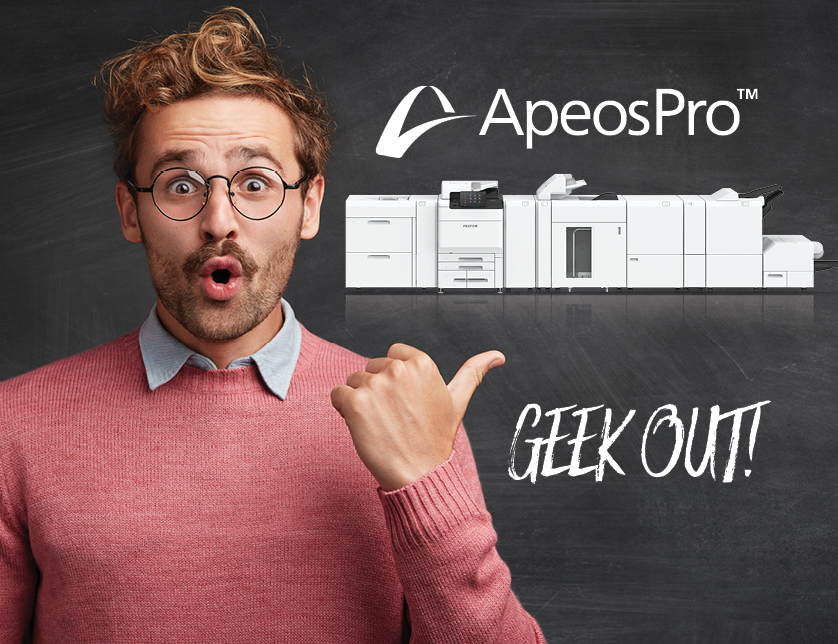 We only think it is fair to warn you that we’re about to geek out a little. We’re going to talk about things like toner transfer. LED printheads. 10-bit RIP rendering. Registration. Fusing temperatures. Paper profiles. Maybe even a little gsm.
If you are down with all of that, you’re among friends.
If you are feeling a little hesitation, stick with us. Sure, we love diving into the technology behind print. And, even though this may all sound a little geeky, all of these specifications and engineering decisions will help understand how you bring more production capability into an everyday print environment without making you and actual “print expert.”
We’d like to introduce you to the ApeosPro. Whether your working in an in-plant, corporate marketing department or print-for-pay environment, the bottom line always comes down to whether or not you can deliver the quality and versatility without all of the complexity.
Color consistency. Media flexibility. Registration. Ease of operation. Security. Workflow.
This is where the real geeky stuff starts to matter.
Geek Out on Image Quality
If you pop the hood on ApeosPro, you’ll find technology and engineering from Fujifilm’s higher-volume production portfolio. Some of the technology is from Fujifilm’s Revoria production presses, including EA-Eco toner technology and a second bias transfer system designed to deliver fine detail, smooth color and consistent toner transfer across a wide range of media.
A next-generation LED printhead delivers resolution up to 2,400 dpi × 2,400 dpi while Graphic Print controllers use 10-bit RIP rendering for smoother gradations and more precise color.
Too geeky, too soon? Maybe. But here is why you should care.
You probably do not spend your day thinking about toner transfer, media and registration. You might move from printing a presentation to scanning documents to producing 500 brochures on a heavier coated stock. The technology matters because you should not have to think about everything happening behind the scenes to make each of those jobs work.
ApeosPro is designed to make these transitions easier, bringing production-class imaging technology into the environment without requiring production-level expertise to use it.
Sweating Out the Details
Are you ready to get geekier? Let’s get to calibration. Color and registration can change as media and production conditions change. A stock running seamlessly under one set of adjustments may need something different the next time around. An experienced production operator understands those variables and knows where to start looking.
The question is what happens when there is no experienced production operator around to make those adjustments. Enter Simple Image Quality Adjustment, or SIQA. You print dedicated charts and scan them using the device’s built-in scanner. ApeosPro analyzes the results and makes adjustments to image transfer, color and alignment.
More geek stuff: The scanner is not just capturing an image, but helping calibrate the device. The printed chart shows ApeosPro how the engine is performing and SIQA uses that feedback to make corrections, removing the need for you to diagnose the issue or figure out which settings need to change.
For the geeks among us, there is lots happening behind the scenes. For example, SIQA can be run at the beginning of the day or whenever you notice something is off. This enables you to address common output issues without immediately calling for service.
It’s Time to Talk Paper
ApeosPro C Series devices handle media from 52 gsm to 350 gsm, extending their range beyond standard office stocks to envelopes, labels, business cards, posters and banner sheets up to approximately 51 inches.
While being able to run a stock is one thing, running it consistently is where the engineering matters. As media gets heavier or more specialized, feeding, toner transfer, fusing and registration can all affect the finished piece. ApeosPro lets users create custom paper profiles that account for those variables, including SIQA adjustments for transfer conditions, alignment and fusing temperatures.
It gets geekier. Up to 100 profiles can be stored, so a stock that has already been dialed in does not have to become a new setup exercise every time it is loaded. The device can return to the established profile and its associated settings, helping make specialized media a repeatable part of production.
The hardware works alongside those profiles. Air-assisted feeding helps stabilize media transport as stocks become heavier while active registration technology helps maintain front-to-back alignment. Together, the technologies provide greater control over the entire path of the sheet rather than simply expanding the media specification on a data sheet.
For marketing departments and in-plants, the flexibility can keep more specialty work in-house. For print-for-pay operations, it can move appropriate jobs away from larger production equipment and free those presses for work better suited to them.
Technology + Geekness = Easy to Use
If you read between the lines of all the aforementioned technology stuff, you’ll find that ease of use of the ApeosPro is the ultimate goal. Thanks to its 10-inch touchscreen and 1-Touch Apps, you configure frequently repeated, multistep processes once and save them as shortcuts. This eliminates the need to rebuild settings every time a job you just ran comes through.
The same thinking extends to uptime. Customer-replaceable units make toner and other designated components easier to swap while paper and toner can be replenished during active production. The goal is not to give everyday users more things to think about. It is to use all the technology we have been geeking out over to give them fewer things to think about.
The work feeding ApeosPro may also come from well beyond the desktop sitting next to it. Integration with Fujifilm IWpro supports cloud collaboration and digital document workflows while compatibility with web-to-print platforms can create a more automated path for ordering and managing print.
For in-plants serving multiple departments, these connections can bring more structure to how jobs enter production and reduce the emails, conversations and manual handoffs surrounding them. Built-in security adds another important layer because the printer is part of the network and the information moving through it needs to be protected.
The Payoff
Ultimately, all the toner transfer, registration, paper profiles, automation and imaging technology serve a simpler purpose by bridging office and production print. Increasingly, more work lives somewhere between the two.
A marketing team may need a short run of high-quality brochures while an in-plant may want to bring more work inside. ApeosPro brings Fujifilm production technology into that middle ground without the footprint or expertise of a larger press.
So okay, while we leaned a little into our geeky side, understanding what is happening behind the scenes helps explain what ApeosPro makes possible in the real world.


