 When I look back at my career, it doesn’t feel like a straight line. It feels more like a series of rooms I’ve been fortunate enough to work in.
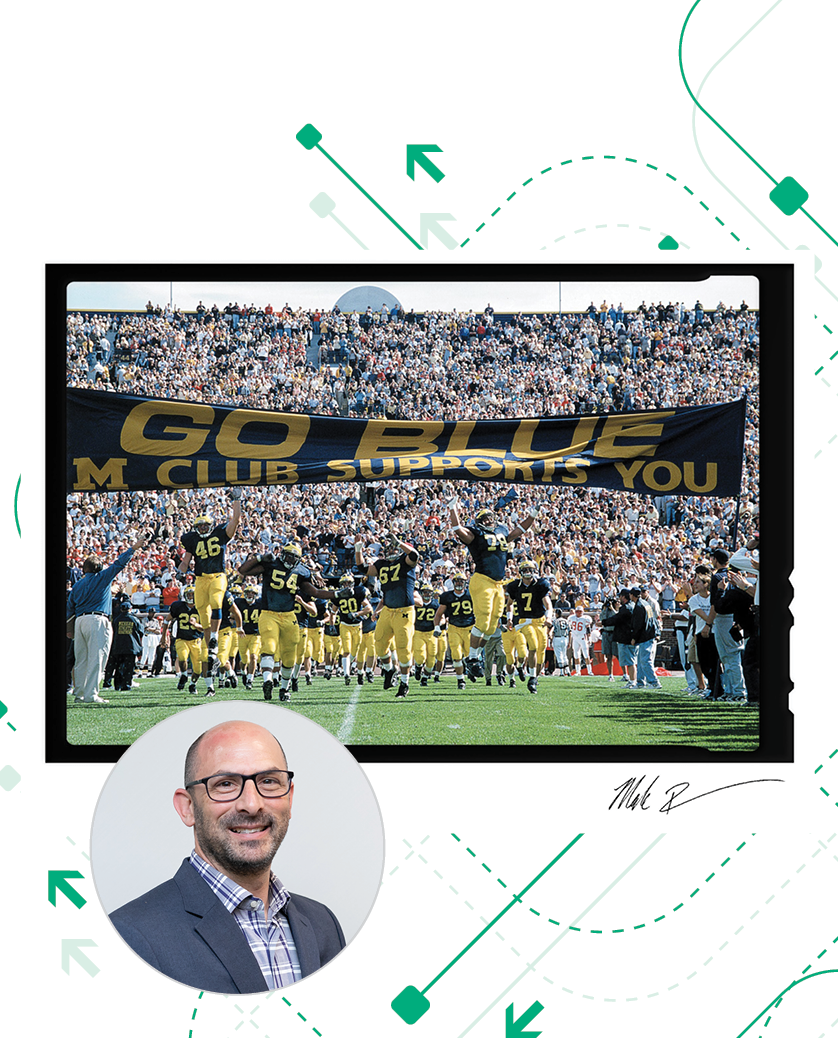
I started behind a camera. We had a darkroom in my house growing up because my dad had a love of photography. We used to joke that what he “loved” was what felt like the eternity of posing the family for portraits on family vacations so we would remember each trip. Maybe that is why I was drawn to sports photography. After graduating from the University of Michigan where I was the photo editor of the Michigan Daily Newspaper that covered all of Michigan’s varsity sports programs, I became a freelance sports photographer covering mostly the NFL and NCAA football in Florida. I was even published in Sports Illustrated. I learned quickly that timing matters. You cannot fake preparation. You cannot Photoshop trust. You either capture the moment or you miss it.
The early part of my career I brought my passion for photography and print together each week. Monday through Friday I worked in print and on the weekends I was on the sidelines of the biggest football games of the week. I rolled up my sleeves and got my hands dirty in photo labs, ad agencies, print shops and even a factory that made photo paper. Eventually life got in the way and my photography gave way to a career in print. I transitioned to roles in product development, business planning, technical sales and ultimately marketing leadership roles. I still have my cameras. You might see me at my kid’s sports events. I am the guy in the corned with the giant lenses trying to capture that one magic moment without posing anybody.
Today, as Vice President of Marketing at Fujifilm North America, I have the privilege of leading a team that spans product marketing, creative, digital, and demonstration. We support customers across the entire genre of print. The work is complex. The environment is fast. The expectations are higher than ever.
And yet, at its core, marketing has not changed. What has changed is the environment around it. We have shifted from face to face conversations to digital touchpoints. From handshakes to hyperlinks. From printed leave behinds to algorithm driven feeds. The speed of information has increased. The permanence of attention has decreased.
At the same time, artificial intelligence is starting to reshape how content is created, how campaigns are optimized, and how buyers evaluate options. AI brings enormous potential. It also brings uncertainty. If everyone has access to the same tools, what becomes the differentiator?
In my view, it is not volume. It is not automation alone. It is not speed for its own sake. It is authenticity and connection. Marketing is not the act of broadcasting. It is the discipline of understanding. It is more listening than it is talking. The more digital our interactions become, the more valuable genuine connection becomes. People still want to feel seen. They want to feel understood. They want to trust that the person or brand on the other side understands their pressures and constraints.
That is where print continues to matter in a profound way. In a world that lives on screens, print is tangible. It slows you down. It invites engagement. It creates presence. A well produced piece of print does something digital rarely achieves. It occupies physical space. It lingers. It feels intentional.
This is not nostalgia. It is strategy. The future is not digital versus print. It is digital and print working together to create experiences that are both efficient and meaningful. Digital drives immediacy and scale. Print delivers permanence and impact. When aligned thoughtfully, they create something stronger than either can alone.
As marketers, we have a responsibility to use every channel wisely. We must embrace innovation without abandoning fundamentals. We must explore AI without surrendering judgment. We must move fast without sacrificing clarity. The world may feel unpredictable. The tools may evolve. But the principles endure.
Clarity. Quality. Trust. Connection.
Those values are not outdated. They are durable. I remain deeply optimistic about the future of print because I see what it enables. I see the craftsmanship. I see the innovation. I see the pride operators take in delivering consistent results shift after shift. And I see how brands still rely on tangible communication to cut through the noise.
At Fujifilm, we are committed to supporting that future. Not by chasing trends, but by enabling customers to create work that is reliable, meaningful, and built to last. Technology will continue to evolve. Markets will continue to shift. Connection will always matter. And marketing, at its best, will always be about helping people experience something real.


