New work is headed your way. The client wants shimmer. They want shine. They want that premium metallic wow factor that makes their brand pop off the page.
But here’s the problem — your standard CMYK press can’t deliver it, and suddenly you’re caught between your client’s expectations and your production reality. Say yes, and you’re looking at separate press runs, complicated setups, production bottlenecks and costs that squeeze your margins. Say no, and you lose the job to a competitor who can figure it out.
The truth? Clients expect metallic printing capabilities, so having them is no longer optional. And CMYK simply can’t fake them. It’s physics, not magic. The good news is that you can deliver in-line metallics without the workflow chaos.
CMYK is a dependable print shop workhorse and has been for decades. Photographs? Check. Gradients? Brilliant. Full-color work? Absolutely.
But metallics? Outside its realm. Here’s why.
CMYK layers cyan, magenta, yellow and black, creating color through light absorption to build the spectrum you need.
Metallics operate on entirely different physics.
True metallic toners have formulations containing actual metal particles, typically microscopic flakes of aluminum, copper or bronze. These particles reflect and scatter light rather than absorbing it. The result? That characteristic shimmer and dimensional shine.
The problem is that you can’t see what’s not there. So while you can print a flat gold color with CMYK, a comparison with a metallic toner instantly shows the difference. No metallic reflectance. No dimensional depth. And your client notices it too.
Standard CMYK has a wide range of colors that are great for continuous-tone images and natural color work, but its gamut is still limited. You can only create so many colors with layering and subtractive mixing.
Vibrant, highly saturated fluorescent colors and specialized finishes like metallics live beyond those borders.
Pantone’s gamut is larger and reaches territory that process printing can’t touch. Metallic colors specifically — rich golds, brilliant silvers, deep bronzes — exist in that range.
You can’t achieve Pantone 871 C Gold with cyan, magenta, yellow and black. It’s just not possible. Try to match it with a toner’s process colors, and you’ll get the closest yellow-orange CMYK can manage. Flatter. Duller. Beyond what traditional CMYK can reproduce.
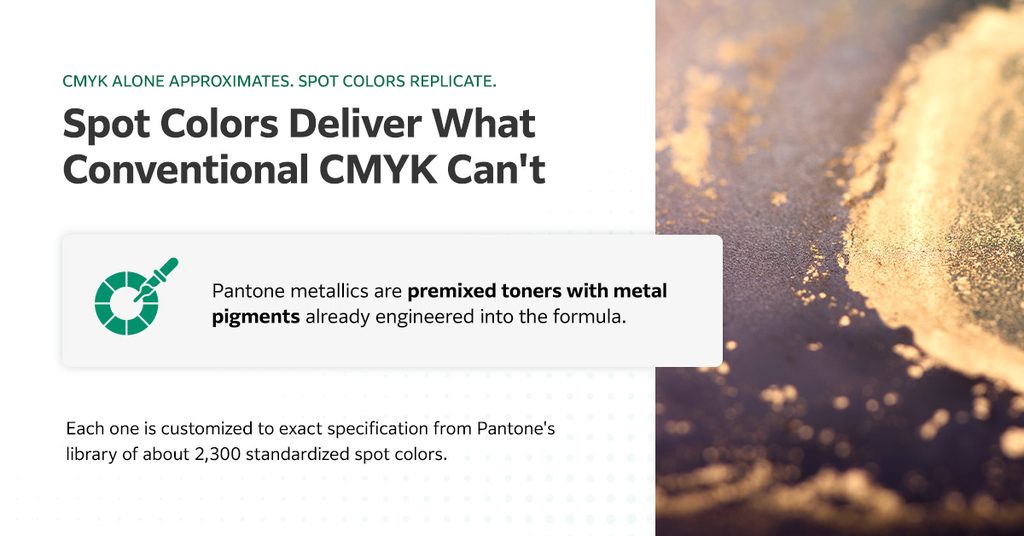
Spot colors and metallics go hand in hand, often using Pantone as a framework. Pantone metallics are premixed toners with metal pigments already engineered into the formula. Gold 8641 C. Silver 877 C. Each one is customized to exact specification from Pantone’s library of about 2,300 standardized spot colors.
One pass, one color, consistent shimmer every time. It’s the difference between printing a gold-adjacent color and actually printing gold.
Consistency demands precision, and that’s exactly what Pantone spot colors deliver for metallics. You’ll see the same silver prints whether you’re running it in Chicago or Atlanta, today or six months from now. The formula doesn’t vary. The color doesn’t shift. The shimmer doesn’t disappear.
This is why brand guidelines often specify Pantone numbers for metallics. They’re the standard for corporate identity work, premium packaging, luxury applications — anywhere brand consistency is contractual or critical, spot colors aren’t optional.
CMYK alone approximates. Spot colors replicate. When your client expects metallics that match across every touch point, spot colors are the only answer.
Recent press innovations tackle both process and precision issues at once by adding specialty color capabilities directly into the digital press workflow.
The traditional objection to spot color use? Expense. Spot colors often mean separate press runs, plate changes and additional makeready time. The impacts ripple. Complexity that slows down throughput. Bottlenecks that produce longer turnarounds. Squeezed margins.
You’ve always had to choose between precision and efficiency in your metallic workflows. Not anymore.
Modern digital presses like the Revoria™ PC1120S, EC2100S and SC285S with CMYK+ embellishment capabilities run specialty metallics in-line with standard CMYK in a single pass. No more separate runs. No more complex setups. No more changeovers.
With CMYK+ embellishment capabilities, the metallic effect is built into the press configuration rather than handled as a separate process after the fact. CMYK still does the core process-color work, while the specialty metallic toner adds the shimmer, reflectance and dimensional effect CMYK alone cannot create.
Say yes to those metallic jobs without worrying about longer turnarounds or tighter margins. The workflow stays streamlined. The shimmer stays real.
Better yet, there are resources to help you make more with this capability. Think free training, design tools, profit guidance and ongoing support for your success.
Today’s CMYK+ presses are designed to work with modern color management systems. Integration capabilities are built right in — maximum value without complicated add-ons. Connect most color measurement tools and access your data from anywhere to have one source of truth for your color workflows.
The result? More consistent metallic output across different jobs, substrates and even locations. No more visual assessments. Just repeatability. That matters more with metallics, because they’re harder to reproduce consistently than standard CMYK. Substrate interaction affects how light reflects off metallic particles. Viewing angles change the appearance. Even lighting conditions shift perception. What looks perfect on one press might look off on another.
With color management, CMYK+ becomes an even stronger competitive edge. There’s one standard across all devices and facilities. Plant A’s gold and Plant B’s gold both fall within tolerances. Tuesday’s run and Thursday’s reorder do the same. You can quote metallic jobs confidently, reduce waste from corrections and ensure brand consistency.
The precision you gain from in-line metallics stays locked in, and what used to be complicated becomes manageable.
Physics doesn’t change — true shimmer demands specialty metallic toners. What has changed is your ability to deliver with CMYK+ and Fujifilm Graphic Systems. Our Revoria™ series, ColorPath® SYNC™ color management software and Aspire Program support are all designed to help you make more shine.
Give your clients the shimmer they expect without the workflow bottlenecks that kill profitability. Explore our innovative Revoria series and the Aspire Program resources to start turning metallic print jobs into a competitive advantage.


